Artwork
Is Your Logo Ready to Be Embroidered?
A logo built for a website is not automatically a logo that stitches. Here is what we look at before your artwork goes anywhere near a machine.
Send whatever you have. A vector file is ideal, but most of our orders start with a PDF from a designer, a business card, a website screenshot, or a photograph of a shirt from four years ago. We will tell you honestly whether what you have works at the size you want it stitched, before you approve a price.
These are the five things we look at.
1. The file
An embroidery machine does not read a logo file at all. It reads a stitch file: a path, a sequence, a density, and a thread color for every section of the design. Converting your artwork into that stitch file is called digitizing, and it is a skilled job rather than a format conversion. We do it here, in house, on our own software.
Practically, that means a high-resolution or vector file saves rebuilding work and therefore money, but a clean printed sample is workable too. What does not work is a small, blurry image pulled off a social profile and scaled up.
2. The smallest letter
This is where most logos fail, and it fails quietly: the mark looks correct on screen and arrives with a tagline you cannot read. A stitched letter needs enough height for the needle to form the shape. Below roughly a quarter of an inch in cap height, fine serifs and thin strokes start to close up.
There are three honest fixes, and we will propose whichever suits: enlarge the small text, drop the tagline from the garment and keep the mark, or move the small text to a placement that can carry it, such as a sleeve or a cap back. Shrinking the whole logo and hoping is not on the list.
3. The fabric it is going on
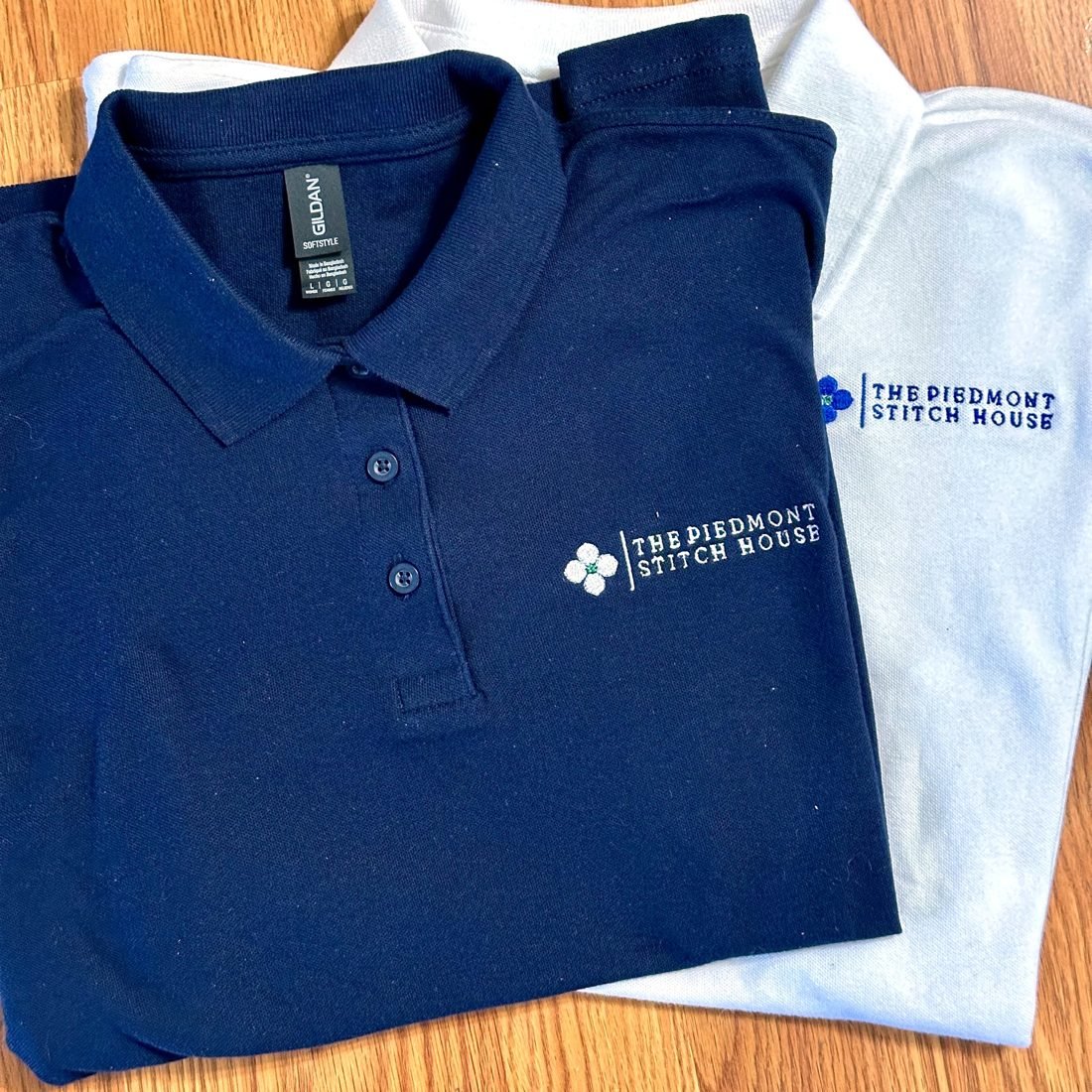
Embroidery is unforgiving of the wrong blank. Fine detail sits cleanest on a flat woven shirt, holds up well on a jersey knit, and has the hardest time on a textured pique polo, where the surface itself competes with the stitches. Fleece needs different backing and density than a woven. A seam-sealed shell has its own constraints.
We would rather steer you to a garment that flatters your logo than stitch the one you named and let you discover the problem at delivery.
4. Color
Thread colors are matched to your brand colors from a standard polyester thread range. The match is close, not identical, because thread is a physical product with a fixed palette. We will tell you which numbers we intend to use, and the stitched proof shows you the result.
Color count is rarely the constraint people expect. Our machine carries fifteen needles, each threaded with a different color, so a detailed mark does not have to be simplified down to one or two colors to be practical.
5. Where it sits
Placement is a design decision that gets treated as an afterthought. A left-chest mark that is correct for a men's cut can sit badly on a women's cut. A cap front has a hard height limit set by the seam and the crown. A jacket back has room your logo may not be built to fill.
We set placement and scale on the proof, on the actual garment style you ordered, and you approve what you will receive.
What digitizing costs, and when it does not
Digitizing is charged once per logo and quoted up front, so you see it before you commit. There is no screen fee and no setup fee on top of it. We keep your stitch file, so when you reorder the same mark there is no new digitizing charge, and the twentieth garment matches the first, including the one you order eighteen months from now.
Send it over
If you are not sure whether your logo is stitchable, send it with a note about the garment you have in mind. We quote in one business day and will say plainly if something needs to change first. Businesses in central North Carolina and Southern Virginia get free delivery; orders ship nationwide.
Talk to us about your order
Most embroidery orders ship in 7–10 business days once you approve the proof. Embroidery starts at 6 pieces, mixable across garment types, and we quote in one business day.